Unveiling the Thrill: A Deep Dive into the Case Opening Experience
The Ultimate Guide to CS:GO Cases: Mechanics, Odds, and the Economy
Few virtual items have captured the gaming world’s attention quite like Counter-Strike: Global Offensive (CS:GO) weapon cases. Even with the release of Counter-Strike 2 (CS2), the legacy and mechanics of the original CS:GO case system remain a massive cultural and economic phenomenon.
For millions of players, the sound of a case spinning—the frantic clicking slowing down, hovering agonizingly between a common blue and a rare yellow—is a universal gaming experience. But beyond the thrill of the gamble, how do CS:GO cases actually work? What are the true odds, and how does the Steam Community Market influence this multi-million dollar virtual economy?
This comprehensive guide breaks down everything one needs to know about CS:GO cases, their drop mechanics, and the economics of virtual skins.
1. How Do CS:GO Cases Work?
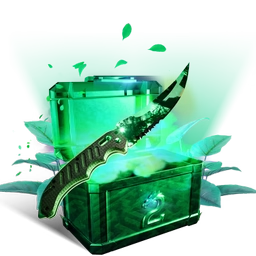
To open a case in Counter-Strike, players need two things: a Weapon Case and a Cryptic Key.
- Acquiring Cases: Cases are primarily earned as random drops by playing on official or community servers via the weekly care package system. They can also be purchased directly from the Steam Community Market.
- Acquiring Keys: Unlike cases, keys cannot be found as drops. They must be purchased directly from the in-game store for a flat rate of £2.50 GBP.
- The Opening Animation: Once a key is used on a corresponding case, a roulette-style wheel spins through the potential weapon finishes inside that specific collection, eventually stopping on one item.
2. Understanding Case Rarities and Drop Odds
It is a well-known secret in the gaming community that the house almost always wins. Valve officially discloses the drop rates for items in cases, and the math heavily favors lower-tier items.
The tier system dictates both the quality and the color-coded rarity of the item received.
| Rarity Tier | Color | Approximate Drop Rate | Description |
|---|---|---|---|
| Consumer / Base Grade | White | 0% (Not in cases) | Standard weapons found in drops, not cases. |
| Mil-Spec Grade | Blue | ~79.92% | The most common outcome; typically standard or lower-tier designs. |
| Restricted | Purple | ~15.98% | Uncommon weapon finishes with more intricate patterns. |
| Classified | Pink | ~3.2% | Rare, highly detailed weapon skins. |
| Covert | Red | ~0.64% | The highest standard tier, featuring the game’s most sought-after non-knife weapons. |
| Rare Special Item | Gold / Yellow | ~0.26% | Knives or Special Gloves (the jackpot). |
(Note: Within each tier, there is an additional random chance that the weapon will feature StatTrak™ technology—which tracks kills—occurring roughly 10% of the time, as well as varying degrees of wear, ranging from Factory New to Battle-Scarred).
3. The CS:GO Case Economy and Trade-Ups
The valuation of items inside CS:GO cases is entirely driven by supply and demand, governed by the Steam Community Market and third-party trading sites.
Why Are Some Cases Worth More Than Others?
- Discontinued Drops: When Valve removes a case from the active drop pool (moving it to the “rare drop list”), its supply becomes finite. As more are opened, fewer exist, driving up the price.
- Desirable Contents: Cases featuring iconic knives (like Karambits or Butterfly Knives) or legendary gun skins (like the AWP Asiimov) command higher prices.
The Trade-Up Contract
For players who tire of getting common blue items, Valve offers the Trade-Up Contract. This mechanic allows players to trade ten weapon skins of the exact same rarity tier for one weapon skin of the next higher tier from a collection of the player’s choice.
While this does not change the fundamental math of the game, it gives players a way to recycle low-value skins into a chance at something better.
4. Tips for Navigating the Case Market
For those interested in participating in the CS:GO case ecosystem, following a few practical guidelines can save money and prevent regret:
- Treat It as Entertainment, Not Investment: Expect to lose money on case openings. The statistical odds are stacked against turning a profit.
- Buy Singles Instead of Opening: If there is a specific skin a player wants, purchasing it directly from the Steam Community Market or a reputable marketplace is almost always cheaper than buying keys and hoping to unbox it.
- Hold onto Active Drops: Players who receive weekly case drops can choose to sell them immediately on the market to slowly build up Steam wallet funds without spending real money.
Frequently Asked Questions (FAQ)
Can I still get CS:GO cases now that CS2 is out?
Yes. Counter-Strike 2 is built on the same inventory and economy backend as CS:GO. All cases, keys, and skins carried over seamlessly into the updated engine. Cases still drop weekly through regular gameplay.
What is the rarest knife in CS:GO cases?
While exact rarities within the “Rare Special Item” category depend on the specific case, knives with specific patterns and wear values—such as a Factory New StatTrak™ Karambit Crimson Web—can command tens of thousands of dollars on the open market.
Are third-party case opening sites safe?
Third-party gambling and case-opening websites operate outside of Valve’s official ecosystem. Many of these sites have murky legal statuses, lack proper regulation, and carry a high risk of scams or losing deposited funds. Exercise extreme caution.
What does “Float Value” mean for weapon skins?
Float value is a numerical value between 0.00 and 1.00 that determines the wear condition of a skin. Lower numbers mean cleaner, more pristine conditions (Factory New), while higher numbers mean heavily worn or scratched textures (Battle-Scarred).
CS:GO cases are a fascinating intersection of gaming, psychology, and economics. Whether viewed as a harmless digital lottery, a collector’s hobby, or a complex financial market, cases remain a core pillar of the Counter-Strike experience. Just remember to keep a level head, set a budget, and enjoy the game for what it is—a masterclass in tactical first-person shooters.
Stay ahead of the CS2 Case Opening market with CS2Skin—browse skin details, case highlights, and useful insights for collectors.